-
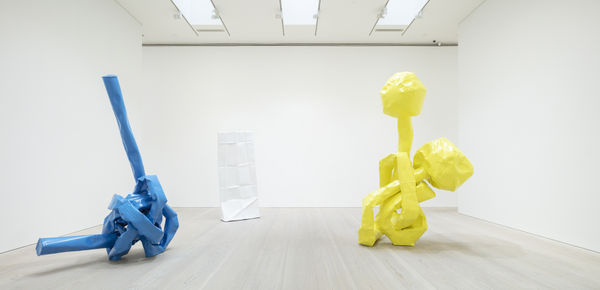
Anna Fasshauer’s sculptural practice is grounded in a physically intensive engagement with aluminum, a material she bends, hammers, and rolls through embodied force. The body operates here not merely as a tool, but as an agent of transformation, actively reshaping industrial matter. Through this process, the material’s presumed stability is disrupted, giving rise to dents, folds, and deformations that reconfigure its formal and spatial logic.
“I begin with pristine, industrial material and deliberately ruin its flatness and straightness. It is construction preceded by destruction,” Fasshauer states. “During the working process, I destroy a lot, but the destructive element does not come from aggression; rather, it stems from a desire and curiosity—the desire to create new possibilities. A bit like reshuffling the cards.”
In this context, destruction does not function as discourse, but rather as a condition through which forms emerge. -
 Anna FasshauerCosmic Cocktail, 2026Aluminium, lacquer155 x 75 x 50 cm
61 x 29 1/2 x 19 3/4 in -
"I try to give my sculptures movement, partly to create an impulse to walk around them."
The surfaces of the sculptures evoke imagined sensations of touch and make tactility a central part of the aesthetic experience. The cold, rigid, industrial material has turned into something surprisingly human – soft and warm. “If looking at the sculptures makes you want to touch them, then a lot has already been achieved,” the artist states.
This dynamic is evident in works such as the bright colored wall sculptures Apollo (xs) (2026) and Tellurium (2026). Folded fan-like, evoking paper or gift wrapping, the works destabilizes expectations of materiality. While constructed from metal, it appears – at a distance – soft, pliable, almost weightless. The coldness of the material, however, ultimately challenges this impression, adding a new dimension to its beauty.
Fasshauer works with aluminum not only for its mechanical properties but also for its everyday familiarity. “Aluminum is a material that we encounter everywhere in daily life,” she explains. “Who hasn’t played with aluminum foil? I chose it primarily because of its technical properties, not because of its history or cultural associations.” This familiarity situates the material within everyday experience, even as it is transformed beyond recognition.
-
Anna FasshauerSyzygy, 2026Aluminium, powder coated
Suitable for outdoor installation220 x 150 x 100 cm
86 5/8 x 59 x 39 3/8 in -
Photo: Michael Witte
-
Anna Fasshauer at Galerie Forsblom
-
Anna Fasshauer
Sculpturology May 8 - June 7, 2026German artist Anna Fasshauer creates sculptures by bending, hammering, and rolling aluminum. Foregrounding embodiment, the intensely physical nature of her process is central to her practice: through sheer strength, her... -
Anna Fasshauer
Hello Sinki September 24 - October 24, 2021Marking her Finnish debut, German artist Anna Fasshauer (b. 1975) will fill Galerie Forsblom with her eye-popping aluminum sculptures, which at first glance appear to be abstract, but soon begin...
-